
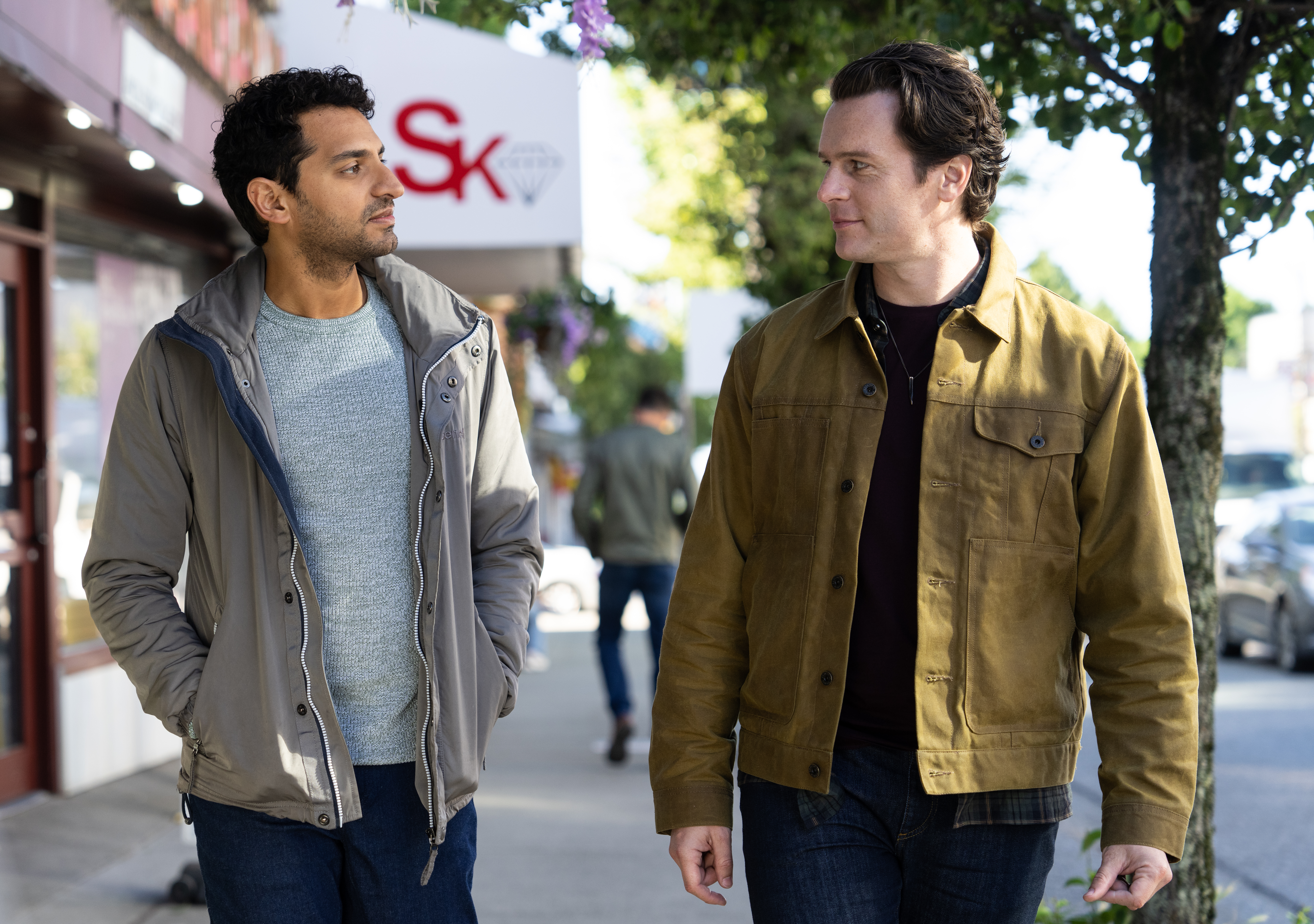
If there was one scene that made rom-com A Nice Indian Boy a viral sensation before it even hit the big screen, it would be this one: Jay (Jonathan Groff) – a confident white man with the voice of an angel (he was on Glee after all) – serenading an introverted Indian-American doctor, Naveen (Karan Soni) with one of Hindi cinema’s most famous 90s songs, Tujhe Dekha Toh. The romantic track is from the film, Dilwale Dulhania Le Jayenge – a 1995 movie that was instrumental in shaping lead actor Shah Rukh Khan’s rise to stardom and heartthrob status.
The clip itself had over 150,000 views on our own TikTok page, and considering the movie has since been released in the US, UK and Canada, and is currently in Australian cinemas, you’d think Khan would’ve noticed this viral, heartwarming nod by now. But according to the movie’s director Roshan Sethi, he hasn’t received official word just yet that SRK has seen the scene.
“To what extent is he aware of it? Probably not at all,” Sethi smiles during an interview with Draw Your Box. “It’s coming out in India later this year, so maybe he’ll become aware of it then. I know many people who know him, but I don’t think it’s gone to him.”
Listen to our podcast interview with Roshan Sethi below:
A Nice Indian Boy is based on Madhuri Shekar’s play of the same name. It follows Naveen and what happens when he introduces his boyfriend Jay – a white man adopted by Indian parents – to his traditional Indian parents. The couple’s journey is hilarious, heartwarming, and at some points heartbreaking, demonstrating the ups and downs of navigating South Asian family dynamics and queer, intercultural love in modern day Canada.
The story is particularly close to Sethi’s heart. The Canadian of Indian heritage is a qualified doctor as well as film director, and is married to Soni in real life. While aspects of his personal experiences as a gay South Asian man are reflected in A Nice Indian Boy, Sethi’s not so confident about the future of diversity in Hollywood. Will we see him make another movie that helps these underrepresented communities feel seen and heard?
“Karan and I were interested in it because of our lived experience… but then also we had our own chance to work on the script and bring elements of our experience into the movie,” says Sethi. “But… I don’t think I’ll ever have the chance to make a gay Indian movie again, because I don’t think anyone will ever finance one again.”
@drawyourbox How do we make this Aussie release happen?! 😍 #aniceindianboy #karansoni #jonathangroff #southasian #ddlj #srk #shahrukhkhan #tujhedekhatoyehjanasanam #desitok #brownboy #browntiktok #bollywood #romcom #indianboy ♬ DDLJ Theme – Jatin-Lalit
It’s a rather bleak – though perhaps realistic – outlook on the future of an industry that has thrown ‘diversity’ around like a shiny buzzword over the past few years. While we’ve seen progress (and A Nice Indian Boy is symbolic of that), Sethi says the political and cultural context of the last five years is important in understanding his view.
“I think it’s about to get worse,” he says. “What’s interesting is a lot of the very progressive movies that have come out in this era, even like The Wedding Banquet, A Nice Indian Boy – all of those were greenlit and financed during a very progressive era in Hollywood. 2020 to 2024 was not only the Biden years. It was also a time in Hollywood that was very influenced by BLM and an interest in diversity that suddenly became very explicit.
“But now we are in a very different political climate, not only in the country, in America, but also in the industry, where there’s definitely no interest in diversity,” Sethi continues. “All of that has retracted, and what they’re interested in is going back to what they feel worked. And what they feel worked was mainly white-led projects.”

But Sethi feels that this approach doesn’t match the way our world is evolving. Multicultural populations continue to grow in western countries, and the likes of Mexico and Brazil have become leading global markets for box office releases, Sethi explains.
“Unfortunately, I don’t think that logic or those numbers have caught up to the people who are making the decisions on what to finance,” he reflects. “But I think we’re actually going to see – this is just my prediction, so I could be wrong – a shortage of diverse content in the next three or four years, and it’s all a consequence of what’s happening at this moment with what’s being greenlit.”
Diversity in front of the camera won’t happen without diverse people, and genuine allies, in key decision-making roles.
“What we really need are people who work at the production companies and at the networks, who are also people of colour and willing to have a more holistic view,” says Sethi. “And not just people of colour, but white people who care and are aware of issues too.”

He highlights that they do exist, and streaming giant Netflix is one leading the charge in this respect.
“These power structures are rapidly changing. Netflix, for example, which is arguably the most powerful entertainment company in the world. The number two there is Bela Bajaria, who’s an Indian woman, and the number three is Dan Lin, who’s an Asian man. So, that structure is really uncommon. I can’t think of another situation like that at any other studio, but Netflix is a big one.
“So it’s not that it’s all bad and it’s all corroded, but at least in the little pockets in the worlds that I work in, which are mainly independent film, it’s pretty, pretty bad.”
If we revert our attention to the conversation around white leads on screens, there’s another one to be had about mixed reactions from diaspora audiences. Recent rom-com films and TV shows, created by South Asians in the west, have often featured a brown lead and a white love interest. Examples include Mindy Kaling’s Never Have I Ever, Simone Ashley’s Picture This, and as some critics have noted, A Nice Indian Boy. Does the production of more progressive, diverse content have to come at a so-called cost: pandering to the white gaze? “Brown Girl, White Guy: The Trope That Won’t Die” is the headline of a recent viral article, published on The Juggernaut.
“I saw an article… actually, on my Instagram feed this morning, sort of talking again about this trope of having one South Asian person and one white person in a rom-com,” I say to Sethi during our interview. I needn’t name the headline or publication before he passionately interjects.
“I just lost my mind over that article,” he says, adding, “what I found really entirely missing in that article was, first of all, they didn’t reach out for comment, because I would have happily said many things about why the trend that they claim to be observing.

“It’s very hard to get any of this made. And a lot of the ecosystem around independent films and even studio films does require there to be not just Indians in the movie, which I think personally, is actually for the betterment of the industry. I think in general, we should be making movies that aren’t all-white or all-Black or all-Asian or all-Indian, but that are heterogeneous, the way our worlds are heterogeneous.
“I’m assuming you’re going to walk out into this room and interact with people who are not Indian. I’m certainly going to today, tomorrow, every day,” he continues. “And the idea that our lives are all occurring within our circumscribed identity is, to me, the more problematic thing to convey, because it makes them less likely to make it and it makes people think I don’t need to watch that movie. It’s for that audience – it’s by them, for them – which I would have said to them [The Juggernaut] if they had asked me.”
The greatest irony for critics to face when watching this film would be that Groff’s character is probably more Indian than most of us. He loves the food, recites mantras, goes to the temple and understands Hindi. He’s the textbook second generation South Asian in parents’ eyes. He is the nicest Indian boy you’ll ever meet.
Starring the likes of Karan Soni, Jonathan Groff, Zarna Garg, Harish Patel, Sunita Mani and more, ‘A Nice Indian Boy’ is in Australian cinemas now. Watch the trailer below:
Top image source: Supplied/Roadshow Films


Leave a Reply