
The author of is this article has chosen to remain anonymous.
Media, arts and literature have always played an important role in questioning societal issues, sparking meaningful conversations, and helping us understand ourselves. And given the current political and social landscape overseas and in Australia – this year’s theme for the Sydney Writers’ Festival couldn’t be more fitting. The theme: ‘Show Me the Truth’.
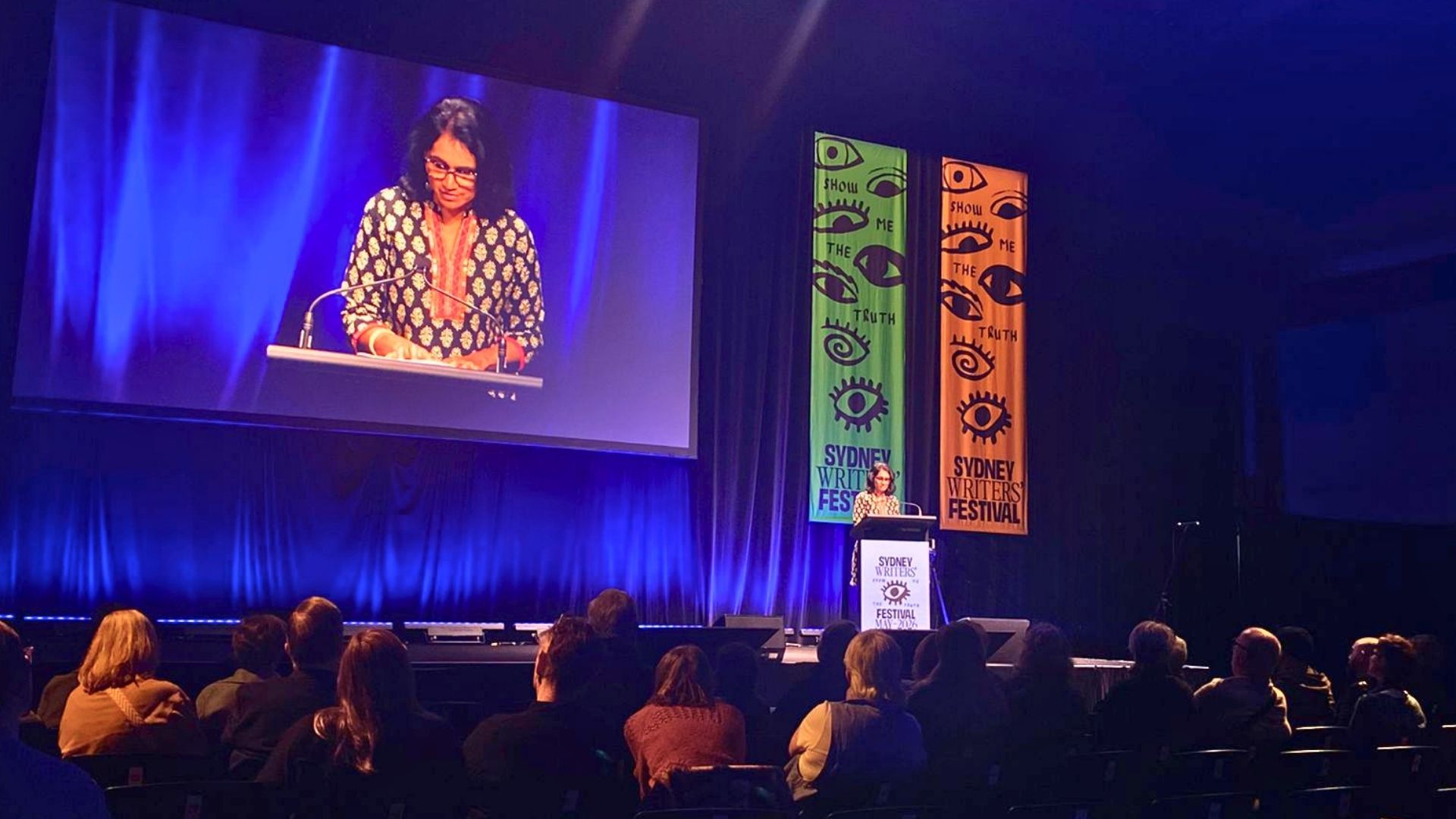
Last week, I became a first-time Sydney Writers’ Festival attendee, watching the closing address called ‘A Braver Australia’, hosted by writer Sisonke Msimang at Sydney’s Carriageworks. From the name itself, I expected a thoughtful discussion that potentially touched on some of the issues I mentioned above. And as a South Asian woman myself, seeing Sri Lankan Tamil author Shankari Chandran in the speaker lineup was an instant drawcard.
When Chandran took to the stage, I felt comforted. Her kurti was not unlike what my mother would wear, and her accent was neither here nor there, much like my own.
Bravery has many different definitions, and in Chandran’s opinion, bravery isn’t required in rooms where everyone agrees, but rather in rooms of disagreement. She said bravery is needed in “conversations we’d rather avoid or in arguments we don’t know yet how to navigate”.
“Bravery can look very small,” she told the audience. “It can look like taking a breath or a few more, instead of shouting, dismissing or avoiding.”

For journalist and political analyst Amy Remeikis, bravery was about holding politicians accountable. She also added that “it’s brave to have optimism”.
“It’s brave to keep fighting, to keep pushing, to keep wanting better,” she said. “And that bravery is nothing without action.”
Aboriginal author Tony Birch said that we are responsible for all those who walk on country, including people of colour and refugees. He said that when we’re in a time of great struggle, we must be brave enough to end the battle, but we can only do that if we look after each other.
Dr Amy Thunig-McGregor spoke about the rise of individualistic media, how communal activities are so important, and how “gathering here tonight and at various events this week is a powerful example of community in action” – going on to say that we, the audience, were already brave: simply by being curious and present.
Writer Jack Toohey said that a braver Australia already exists. He said that a braver Australia is “being built everyday by communities who can’t afford to wait for permission”.
Meanwhile artist Ben Quilty rounded off the evening, calling for a society that “values its dreamers and visionaries… and join the audience in stadiums like this – stadiums for thought.” He added that it is our responsibility to stand up for thought and champion the arts.
The panellists spoke openly of genocide, politicians and the importance of community in our individualistic society. However, beyond what they said, it was the event itself that made me think. We live in a time where the arts are threatened, where AI is rampant and where speaking out for what you believe in can get you killed in some parts of the world. This is precisely why festivals like this – or stadiums for thought, as Quilty would say – are so important.

In January, the Adelaide Writer’s Week was cancelled after they rescinded their invitation to Palestinian Australian author, Dr. Randa Abdel-Fattah. Following her disinvitation, many authors dropped out and board members stepped down in response. In February, the Sydney Writer’s Festival announced Abdel-Fattah in their speaker lineup.
Last month, the Australian Bureau of Statistics reported Indians are now the largest migrant group in Australia. As a daughter of Indian immigrants, I believe that my community’s voices in media are paramount at a time when racism is rife and migrant crackdowns form political agendas.
The mere fact that the Sydney Writers’ Festival exists, and that authors of colour and First Nations communities are part of these discussions, is a privilege. It’s a privilege that shouldn’t have to be a privilege, because uplifting the arts and championing diverse voices should be the bare minimum in reflecting multicultural Australia.
The speakers on the panel taught me that Australia needs to protect everyone, be curious and present, take action for a better world and uplift the arts. They taught me that we need to speak up on what matters to us, including and especially the uncomfortable conversations no one wants to have.
Now, more than ever, Australia needs to be brave.
Draw Your Box is your go-to South Asian publication and media company in Australia. Follow Draw Your Box on Instagram here and TikTok here. For brand partnership enquiries, email alicia@drawyourbox.com. You can also subscribe to our newsletter and podcast below.


Leave a Reply