
As someone who has just written a satirical play about corporate Australia, it may come as a surprise to you that some of my happiest years working were spent in a big office with town halls, no work from home days, and daily stand ups.
When I first moved into analytics in 2015, I found something I never expected – a sense of belonging. In my field specifically, I felt surrounded by people whose brains worked similarly to mine. Analytical, always questioning, hard working, and just the right kind of lame funny. But what made it genuinely special went beyond that. My colleagues – many of whom are still close friends today – came from completely different genders, ethnicities, financial situations, and educational backgrounds. That opportunity to talk to, understand, and work alongside people so different from me every single day was something I was deeply grateful for.
Prior to that, I had worked in consulting, where most people had gone to the same schools and universities, done the same degrees, and were largely moving through the same social circles. The contrast was stark. What I came to appreciate about a big, diverse workplace was that you cannot curate who surrounds you. You have to learn to get along with people who are different from you. You don’t get to opt out of that – and I genuinely believe we are better for it.

The best part was that none of our differences mattered in the end. What mattered was how we showed up as a team, how hard we worked, how much we laughed, and how much we genuinely cared about doing the job well.
So when I tell you things have changed… well, that is not cynicism. That is me being honest about something I have watched happen to people I care about, and to an environment I once genuinely loved.
So then AI happened.
What felt like a gradual technological change has, I believe, turned into one of the most significant shifts corporate Australia has had in decades.
First it was the language. Leaders who could not stop talking about what they had got AI to do. Presentations full of AI-generated content, riddled with errors that nobody had checked, because the point wasn’t accuracy — the point was demonstrating that you were across it.
Then came the mandates. Embed AI into everything. Move faster, and do more with less. Quotas on how many tokens you need to use daily without any consideration for whether that is effective use.
And then finally – redundancies, layoffs, organisational restructures. I know more people who have been made redundant in the last 12 months than in the entire decade before it. the people who actually do the work keep disappearing, while leadership teams are somehow getting bigger. I was made redundant myself during the period I was producing this show. The timing was not lost on me.
And underneath all of it, the question nobody is asking out loud is this: ‘Each day I use AI, am I just making myself redundant?’
What I keep noticing though is that very few people are stopping to think about where they actually stand on any of this. In the hustle to keep up, people are compromising the quality of their work, and more quietly, the quality of themselves. They’re letting key decision makers tell them how to feel about AI, how fast to adopt it, and what it means for their role, without ever carving out the space to decide for themselves. Everyone is exhausted. A lot of people are disillusioned. And almost everyone I have spoken to is carrying some version of the same feeling: that the corporate world they signed up for, worked hard in (and maybe even loved), is being restructured around them in real time and they feel completely at a loss.
So, I did what made sense to me. I wrote a show about it. One that I hope gives people some room to breathe, to reflect, and to make some conscious decisions about where they stand.

The Algorithm of Us
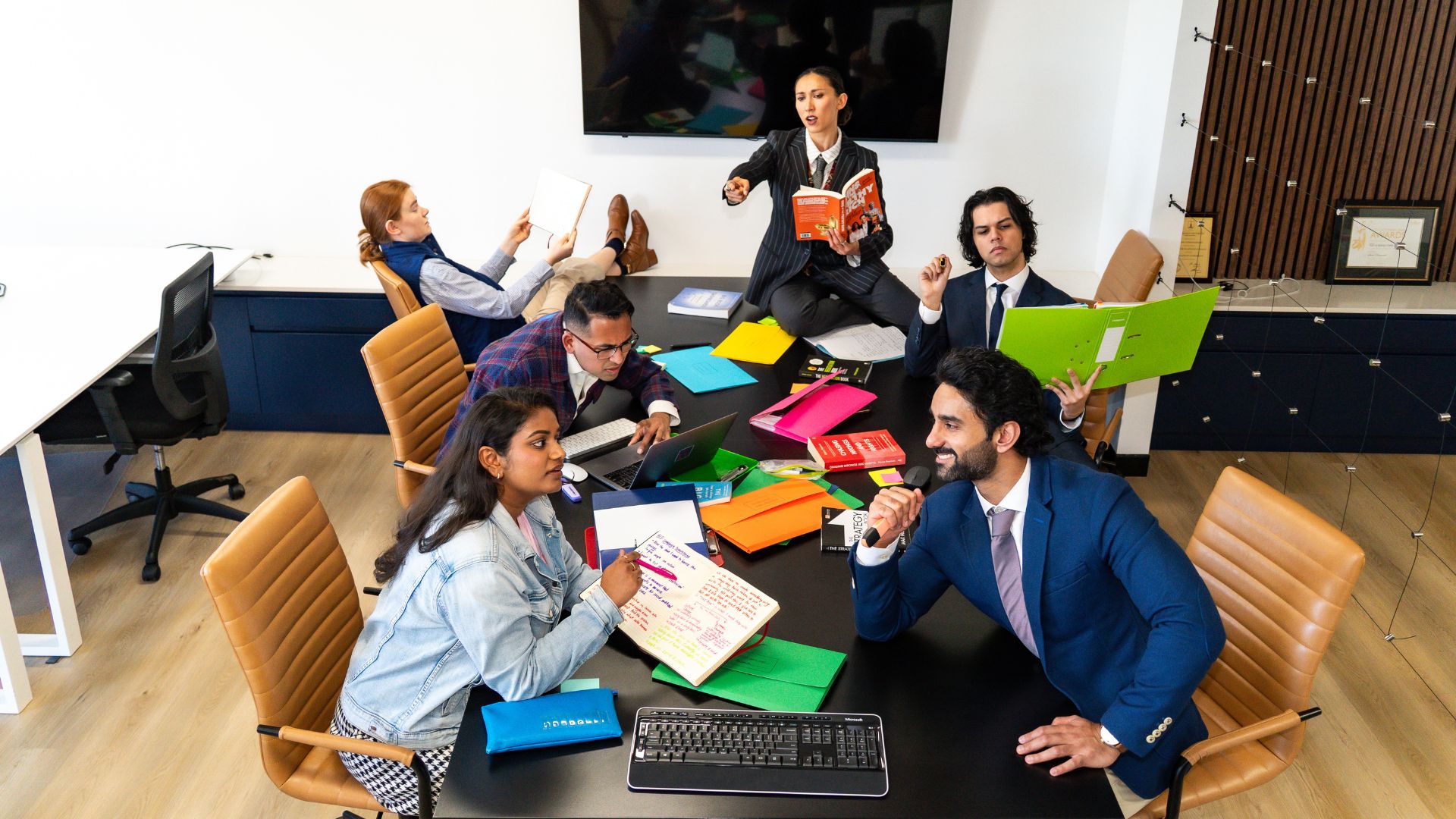
The Algorithm of Us is a satirical romantic comedy set in corporate Australia. It follows Laari, a data analyst who builds an AI agent on the side – which accidentally sends a company-wide email and lands her on a project team alongside management consultants whose ways of doing business are completely at odds with everything she believes in. Then she meets Vee, a consultant who represents everything she doesn’t align with. And she cannot stop talking to him.
It is funny. Yes, because the situation is ridiculous, but also because what we all need right now is a good laugh. It is also about something real.
I want to be clear: I am not against AI.
AI genuinely helps me run BCD Theatre, and I wouldn’t be able to keep it afloat alongside full-time work without AI. But I have my own relationship with it, and I have thought carefully about where I draw the line. I use it to prototype, to brainstorm, to challenge my thinking. What I won’t do is use it to replace the human touch on something that matters.
Here is the question I keep coming back to: If we watched a film where every element – the script, the performances, the direction, the edit – was generated by AI, would we want to watch it? When someone asked me that recently, I instantly said no. But it took me a while to understand why.
I think it’s because without human struggle, without human choice, without the knowledge that someone made a thousand decisions to get here and some of them were wrong and they kept going anyway – the output feels hollow. Technically impressive, but empty. I think of it like watching a robot do gymnastics rather than a human athlete. Without the story behind the performance, something essential is missing from the experience of watching it.
We are being asked to adopt tools at a pace that doesn’t leave room for that kind of reflection. And I think that is worth pausing on.
The show is not just about AI though.
It is about the broader question of what we sacrifice to stay relevant, stay employed, and stay sane inside a system that is changing faster than the humans inside it. The small compromises. The meetings you sit through without pushing back. The ideas you don’t raise because you have learned that raising ideas has a cost. The version of yourself you leave at the door every morning because bringing the whole thing in feels like too much of a risk.
But it is also – and this matters to me – about the people. About the fact that even inside a system with real problems, there are real human beings showing up every day trying to do good work, be good colleagues, and find some meaning in the eight, nine, ten hours they spend there. I wanted to write something that held both of those things at once. The absurdity and the warmth. The satire and the genuine affection for the people inside it.
I also wrote this show because a lot of the people I love are not theatregoers.
Not because they are not interested in stories – they are. But because somewhere along the way, theatre started to feel like it was not for them. Too expensive to risk on something they might not connect with. Too unfamiliar. Too much of a leap.
I wanted to write something that felt like an invitation. A show where someone who has spent the last five years building dashboards, sitting through town halls, and typing “as per my previous email” walks in and thinks, ‘Oh, this is about me. I am in here somewhere’.
Because they are. We all are. That is the whole point.
The Algorithm of Us premieres at Sydney Fringe Festival 2026, 16–19 September at Pottery Lane Performance Space, Lane Cove. Tickets $59 here.
Draw Your Box is your go-to South Asian publication and media company in Australia. Follow Draw Your Box on Instagram here and TikTok here. For brand partnership enquiries, email alicia@drawyourbox.com. You can also subscribe to our newsletter and podcast below.



Leave a Reply